
Facade former U.S. Embassy in Oslo, Norway, photo by Yiorgis Yerolymbos
SESSION CHAIR: Jorge Otero Pailos, Columbia University GSAPP
A significant portion of U.S. diplomacy relies on the stewardship of culturally significant properties in foreign nations. Following World War II, the U.S. Department of State launched a program aimed at advancing diplomacy through the design of its new Embassy buildings. American architects were tasked with designing structures that not only harmonized with the host country’s culture and customs but also projected a distinct ‘American’ identity to the world. This identity promoted the tenets of Modernism, democracy, and the values of freedom and openness. During this period, several embassies were constructed by notable architects. Over the last 50 years, changes to the political climate and the resulting need for increased security made many of the original features that demonstrated this openness and accessibility less apparent; many of the aesthetic, architectural and urban connections to the local communities are now lost.
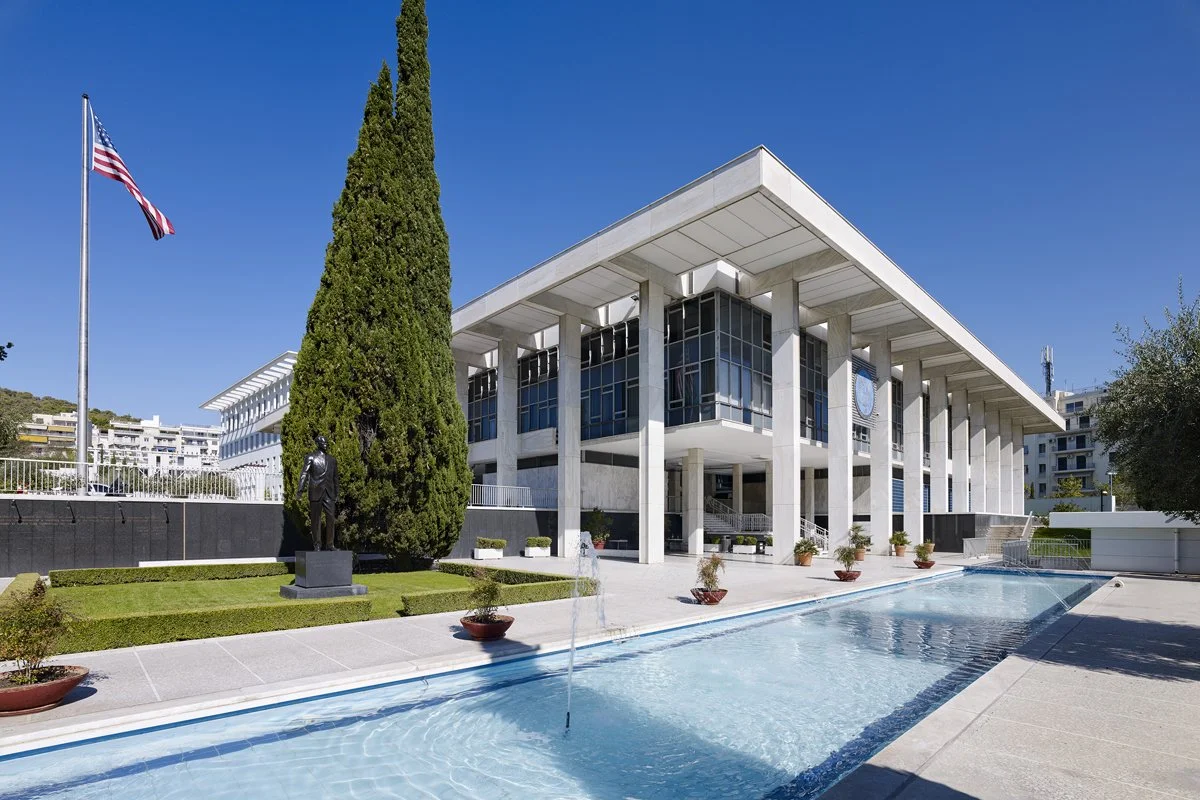
This session, sponsored by the US Department of State, Bureau of Overseas Buildings Operations (OBO), will explore stewardship within the context of diplomacy, highlighting two important buildings. In Athens, Greece, the U.S. Embassy building designed by Walter Gropius was completed in 1961. OBO has made the commitment to renew the building and site, balancing the sometimes-competing future- looking programming and performance needs while preserving the integrity of the historic architectural fabric. The renovation and renewal is being led by Boston based Annum Architects (formerly Ann Beha Architects).
In Oslo, Norway, the U.S. Embassy building designed by Eero Saarinen was completed in 1959. OBO made the determination that renewing the building was not viable without detrimental effects to the original building. In 2017, it was acquired by a developer, Fredensborg, who oversaw an extensive renovation. The building, now called the “Ambassaden” is mixed-use, with offices, restaurants and events spaces. The restoration was led by Atelier Oslo and Lundhagem, with preservation architects Erik Langdalen and Jorge Otero-Pailos.
Both buildings involve significant restoration efforts, as well as modernization with new expansions that respect the original buildings’ historic characters. We will use specific examples of key project features to show how preservation, renewal and rehabilitation contribute to attaining stewardship objectives in both project scenarios.
Jorge Salcedo, Acting Director Office of Cultural Heritage, Department of State, Bureau of Overseas Building Operations
Katie Gerner, AIA, Associate Principal Annum Architects
Jorge Otero-Pailos, Artist, Architect, Professor and Director of Historic Preservation at Columbia University GSAPP
Svein Lund, Architect, Founding Partner & Chairman Lundhagem Arkitekter
Jonas Norsted, Partner/Architect Atelier Oslo Arkitekter